
We Can’t Hire A New City Manager Without Input From The Arts Community
Item S-5 directed the City Manager to seek community input regarding this position. Artists were going to be consulted on the qualities and skills we should seek in the new Arts and Culture Manager. But the job announcement is already out… and we have not seen any calls for input from artists.
So we took a shortcut as well, and came up with a way for Richmond artists to tell us what a good Arts Manager does and doesn’t do. Fill out this short form. We will share the results with City Staff during our meeting with them at the end of the month.
A Successful Call to Action
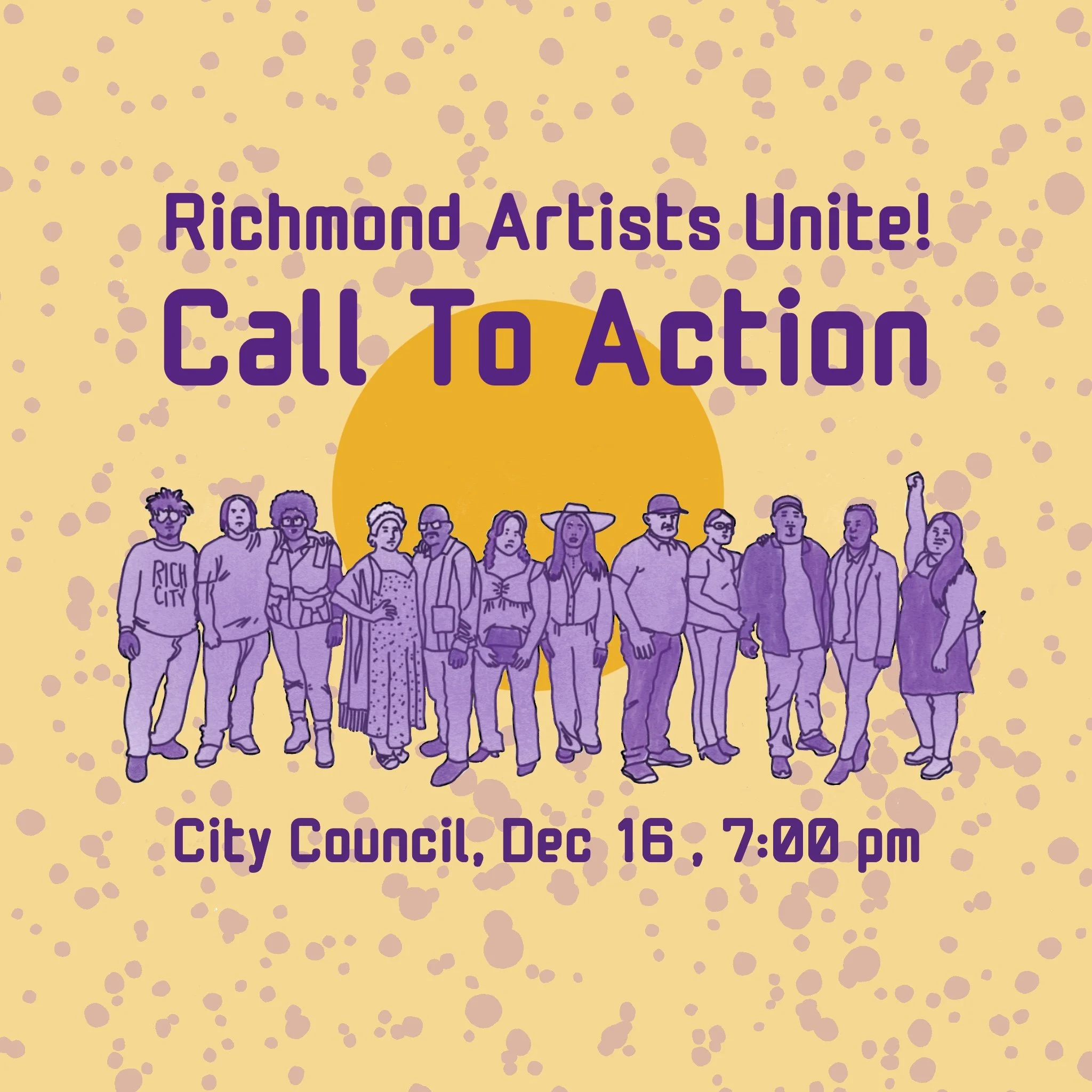
What Happened During the Dec 16 City Council Meeting?
Item S-5 passed unanimously at the December 16 City Council meeting. Our item, originally dead last in the queue, was moved ahead enough to allow us to make a case for artist representation and the revision of our public art programs.
The City Manager will report on the progress of this item during the City's mid-year budget discussion. This item opens the door for artists to participate in focus groups, working groups and surveys asking what we think is important in requirements, contracting and payment of public art grants.
This is wonderful for Richmond artists, but it is also important to remember that there will be change, but only if we participate. What we want is for artists to attend the meetings where changes are described by City staff, so we can offer best practices and specific feedback on the impact those changes might have on artists. Our last two meetings with staff have been very positive and productive, so there's no reason to think otherwise.
We want to thank all the people who made this possible:
Thank you to the Richmond Art Advocates: Sally Hindman, Gayle McLaughlin, Phillip Mehas, Michele Seville, Kate Sibley, and particularly Kaelen Van Cura!
Thank you to the City Manager, the Deputy City Manager and to all the division directors for listening to our concerns and thinking about potential solutions with us.
Thank you to Council Member Claudia Jiménez, who attended our artist meeting and placed the item on the agenda.
Thank you to Mayor Eduardo Martinez and his Chief of Staff Tony Tamayo, for all of their explicit support.
Thank you to the artists who met with staff on 12/16: Deontá Allen, Tiara Amar, Todd Gilens, and John Wehrle. There will be another meeting in January!
Thank you to the artists, musicians and supporters who spoke to the City Council: Tiara Amar, Allison Deong, Mario Guarneli, Duane Oakley, Michele Seville, Kate Sibley, and John Wehrle.
And a big thank you to all the artists and supporters who sent in their written comments: Sadiqeh Agah, Brian Conery, Adrian Delgado, Phoebe Deutsch, Frederick Franklin, Regina Gilligan, Todd Gilens, Bruce Kaplan, Gayle McLaughlin, Cheryl Maier, Carmen Melendez, Patricia Pintner, Michele Seville, Kate Sibley, and Nichole Talbott.
There were several non-profits and many more artists who did not feel they could openly support us at this time. You can still support this effort by attending the meetings where artist feedback will be requested. We really do need everyone!
What Did RAA Discuss With The Staff On 12/1?
Increasing grant awards so they can cover the cost of meeting the grant requirements
Payment advances so the cost of requirements can be met prior to the contract getting signed
The need to diversify the applicant pool by offering additional support tailored to emerging and community artists
Hiring more staff so wait times can be reduced
Simplifying the grant application process
The formation of a working group that includes artists that would revamp the NPA program
Getting artist input on the selection of the new Arts and Culture Manager
Creating an onboarding program for RACC commissioners and expanding their number
Having the 2025 NPA grantees pilot whatever changes are made
There are also several areas in which there is tension, most notably the waiver of insurance requirements. That's why they need to hear from artists directly. We cannot emphasize enough the importance of continuing to exert pressure on the City for real change to take place.
It Is Time For Us To Speak Out
The City of Richmond staff agrees that reforms to our public art program are needed.
Richmond loses artists, art commissioners-and the trust of its residents, when it neglects issues that can be addressed by working together.
Artists are calling for more transparency and community participation as we solve these issues.
Our Public Art Program is only as good as our ability to participate in the changes we need
Testimonials From Richmond’s Artists
Consider that for every artist and organization willing to go public there are several more who won’t do it for fear of retaliation:
Tiffany Conway-Cornelius
In 2023 Public Art Advisory Committee and the Richmond Arts and Culture Commission awarded artists Tiffany Conway -Cornelius and Ari Takata-Vazquez $100,000 for their sculpture titled Living Room, to be located at Kennedy Park. The artists spent months meeting the project’s requirements without a contract. Upon learning that the first payment would be made at least 45 days after submission of their invoice, they unsuccessfully tried to negotiate a shorter payment turnaround. They were advised to either get a fiscal sponsor or take out a personal loan. Tiffany maxed out her credit card in order to pay for the up-front costs ($7,000), but the award was rescinded after a year without explanation. Tiffany took a second job to pay for the credit card debt their project generated.
Rebeca Garcia-Gonzalez
Rebeca was the lead artist of the large restoration project of two of John Wehrle’s murals under the highway 80 underpass. In 2023 and prior to the contract being signed, she had to convince the project’s team of nine artists to individually purchase general liability insurance at $800. The crew waited for more than a year and never got to begin work because of city-generated delays. The Arts and Culture manager promised she’d find the money to get them reimbursed, but then she said that the City didn't have the money to do so, and that the crew would have to wait until they got paid from the contract. After six months of this, Rebeca was forced to use her own money to reimburse three of those artists for fear they would leave the project. She later resigned from her lead artist position once she ran out of funds. She was finally was reimbursed in 2025.
Regina Gilligan
In 2024 Regina was awarded $5,000 through an NPA grant. Her California natives mural was going to be completed in Mendocino Park, in the Richmond Annex neighborhood. Early on she noticed a “lack of transparency regarding expectations” from the Arts and Culture Manager. Finding that the requirements greatly exceeded the risk generated by the project, she sought help from a City official in Parks and Recreation who came up with a workaround, but this solution was rejected. She was later informed that she could only paint the small mural under a general contractor’s contract, who would keep at least 10% of the contract. The nail in the coffin was that the expenses generated by the requirements ate her fee ($2,000). The manager told Regina that the funds “couldn't be released before paying the fees because the Risk Management Office wouldn’t allow it.” These unsurmountable obstacles forced Regina to withdraw her project.
Richard Muro Salazar
Richard was the lead artist for the $451,000, 2,800 square foot mural spanning 88 soundwall panels at the entrance of Parchester Village. It was a Love Your Block and Arts and Culture Division project. As the lead artist, he used the first payment from the project to pay his crew, supplies and equipment, reasoning that he would pay himself out of the second payment. But even though he “met all his benchmarks,” Richard experienced delays with each of his seven payments It took them almost 10 months to pay the 5th payment where. They said the mural wasn’t 100% finished, so they finished the mural. Then the reason was that their insurance didn’t meet the contract requirements. So Richard updated his insurance. After involving the city manager, he only received half the payment after 5 months. Richard was forced to pay $3,000 for hazmat coverage in order to receive the 2nd half. The sixth payment went smoother once Richard began working with the city manager directly. The Arts and Culture Manager would not release the last payment until Richard provided a financial report which I was not required.
Jennifer Riggs
Her 2024 project was a collaboration with two non-profits and a business. They were going to create a mobile mural with youth and families from one of the non-profits. The theme was Richmond and the environment, and it was going to be displayed at three Richmond locales. There were checklists but “the deadlines changed as they went along.” Jennifer turned in all of the required paperwork plus proof of insurance on time, but the contract was never approved and she never recouped the money she spent on insurance fees. There were continual delays and Jennifer’s relationship with her community partner was severely impacted by the delays. Because she was the contact and had to keep delaying the project implementation, the partnerships soured. “Non-profit partners can't work this way.” Her contract was never approved.
John Wehrle
After years of paying out of pocket for the graffitti abatement of his public work in the city, John became the original lead artist of the large project that began in 2022, the restoration of two of his murals painted during the 1990’s under the highway 80 underpass. Risk Management had told him that the pollution insurance requirement had been waived. But then a new department head came on board and she reinstated it. We protested this, to no avail. His team researched the cost and found out was going to be $22,500 for our 9 artist team. The lead artist was then asked to write a pollution plan which was turned in. Risk Management finally waived this requirement after the project director intervened, because it would have been too costly.
Tiny Village Spirit
Tiny Village project is a tiny non-profit with a volunteer staff. This project provides 12 units of dedicated housing supporting unsheltered young people. Tiny Village Spirit was awarded $9,000 specifically to pay for the small mural part of this much larger project. TVS’s total budget for the panel project was $15,000. Richmond high school students presented their mural designs to the RAC six months ago, but they have yet to paint them because Risk Management did not waive a pollution insurance requirement that would cost almost half as much as the grant award itself. Update: their pollution insurance requirement was very recently waived and three years later, they can proceed with their project.
Anonymous Small Non-Profit
"We experienced extremely long delays in both the contracting process and the funding release process, often lasting more than six months. Despite being proactive with communication and documentation, this inefficiency prevented timely service delivery and cash flow management… The recurring delays—which affect not only RACC grants but also ECIA funding and current vendor agreements—suggest the City is not structured well… and this needs to be addressed structurally.”
Richmond Art Advocates
Richmond Arts Advocates is a grassroots group of artists, former RACC commissioners and non-profit leaders in the arts convened by former Richmond Mayor Gayle McLaughlin during the fall of 2024. RAA is urging City officials to change and improve the process through which the City of Richmond works with individual artists and arts organizations..
RAA is currently working to gain representation in the selection panel for the City’s new Arts and Culture Manager. This group composed of artists, former arts commissioners and a former arts manager has also fought to get Tiny House Village Neighborhood Public Art grant approved, and advocated for the prompt payment of other public artists.